
On 24 September 2026, during the 63rd session of the United Nations Human Rights Council in Geneva, during the dialogue with the Expert Mechanism on the Rights of Indigenous Peoples (which presented the study on the rights of Indigenous Peoples in situations of conflict and post-conflict), a representative of the Associazione Comunità Papa Giovanni XXIII (APG23) brought the situation of the Mapuche people in Chile to the attention of the assembly, drawing attention to the deep-rooted injustices that have long marked the relationship between Mapuche communities and the State.
CHILE-MAPUCHE
News
We are not afraid!
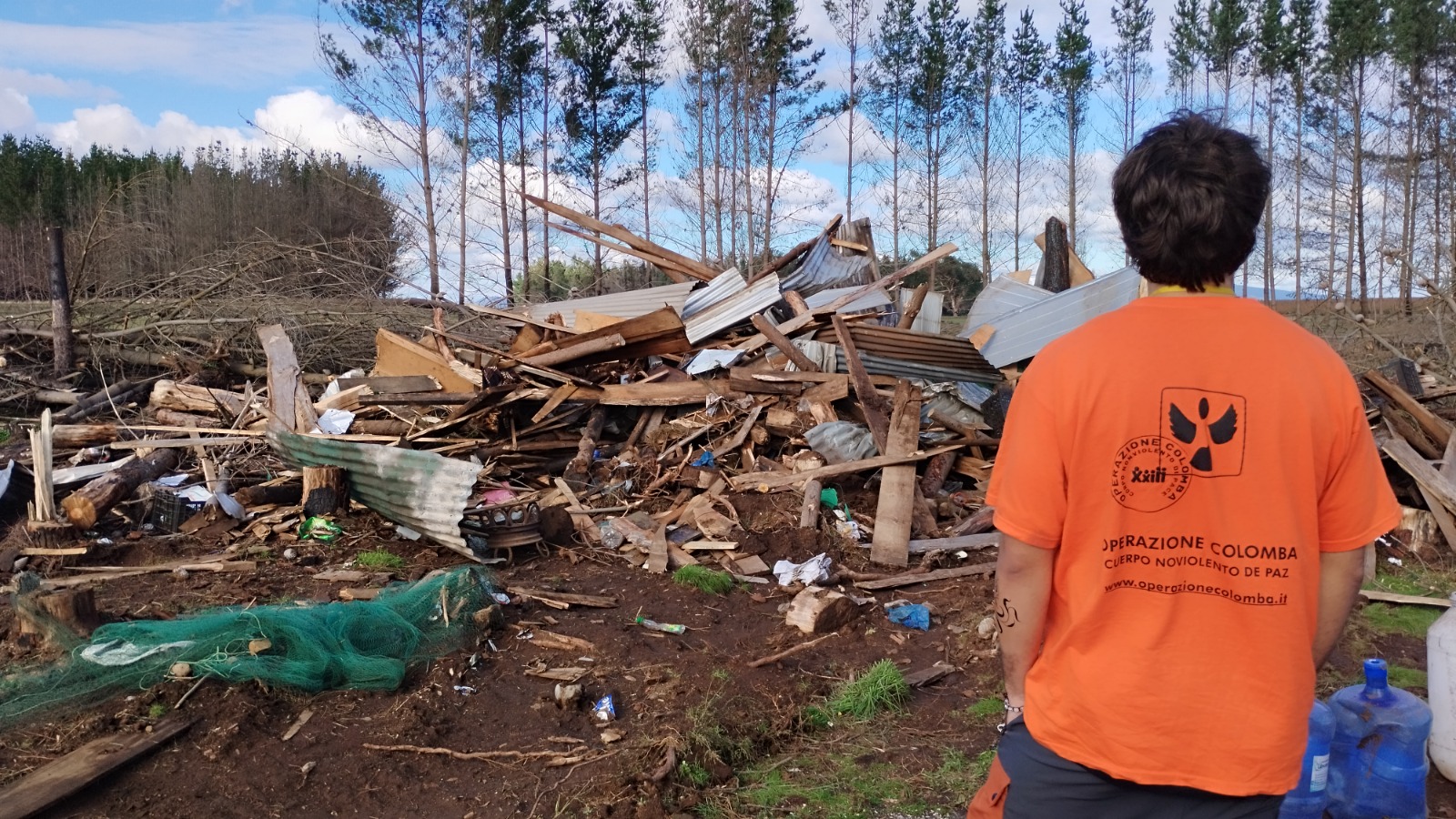
M. is an old lady, the first time I saw her she was at a protest and, despite the rain, she was walking barefoot.
We met her multiple times during protests or on public occasions in front of the prison in Temuco, where many Mapuche gather to transmit newen (energy) to Mapuche prisoners locked up inside.
I began to get to know her better in a shack, in the middle of a field, at the border of a land in the process of “recuperacion”, of land restitution (an expression used by the Mapuche to tell the phenomenon of restitution and occupation of the lands, taken from them through violence during the “Pacification of Arucania”- a military and political campaign, carried out in Chile between 1861 and 1883, with the aim of conquering and submitting the lands inhabited by the Mapuche).
The Cordillera of Shattered Dreams

Chile from the Estallido Social to the Triumph of the Far Right
“If Pinochet were alive, he would vote for me.” This statement alone would suffice to describe the significance of what happened in Chile on Sunday, December 14, 2025, the day of the last presidential election. The statement was made a few years ago by José Antonio Kast, who took office as President of the Republic on March 11.1
From the very beginning of his term, Kast has implemented a series of measures consistent with the framework of his declared “emergency government,” such as a border control plan that calls for the construction of physical barriers, accompanied by the use of drones and the deployment of the armed forces along the northern border to strengthen efforts to combat immigration2. Among the executive branch’s first actions was the suspension of numerous environmental decrees, marking an immediate break with climate policies3. Finally, the President recently confirmed his intention to grant pardons to law enforcement officers convicted for their role in suppressing the 2019 protests4.
Social Forum of the UN Human Rights Council
In Geneva, during the Social Forum of the UN Human Rights Council (October 30–31, 2025), a representative of the Pope John XXIII Community took the floor to draw attention to the situation of the Mapuche people in Chile, who still face deep challenges in having their cultural identity, territories, and traditional knowledge recognized. She denounced the ongoing issues: the limited understanding of Mapuche customs and worldview by institutions, and the criminalization of those who defend their culture and land.
Education can and must become a space for encounter, capable of preserving collective memory, valuing diversity, and transmitting ancient knowledge to new generations. Only education rooted in respect and dialogue can help build more just, inclusive, and sustainable societies.
To watch the full video with all the speeches:
https://webtv.un.org/en/asset/k18/k180qt8b0v
United Nations Human Rights Council on Indigenous Peoples
On Wednesday, September 24, in Geneva, during the 60th session of the United Nations Human Rights Council, the annual panel discussion on the rights of Indigenous Peoples took place, entitled
“Rights of Indigenous Peoples in the context of a just transition to sustainable energy systems, including in relation to critical minerals.”
Representatives of APG23 have taken the floor, bringing the voice of those who suffer the consequences of unjust development models. In the name of the energy transition, large-scale projects are realised that destroy the environment, harm biodiversity, and entrench new inequalities.
 OPERAZIONE COLOMBA


