
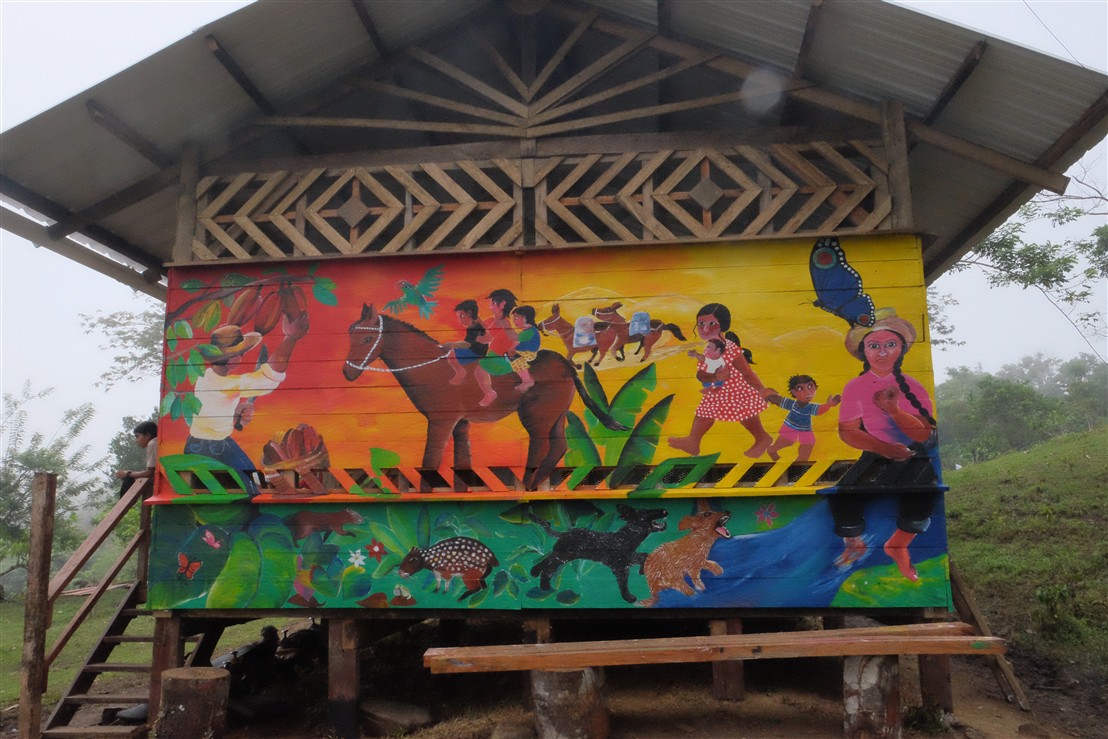
On May 16, we were in a village called La Resbalosa, where the Comunidad de Paz (Peace Community) owns collective land. There, two monuments were inaugurated in memory of the victims of the massacre of 21 February 2005.
On the morning of that 21 February, the XVII brigade of the army, jointly with the paramilitaries, wanting to attack the community directly and in a premeditated way, first went to the Río Mulatos, near what is today the "Luis Eduardo Guerra" hamlet, an hour and a half away from La Resbalosa, where Deiner, aged 11, Luis Eduardo Guerra, his father and leader of the community, and his partner Bellanira, were arriving to go harvest cocoa.
Upon arriving, the paramilitaries spared none of the three, cutting off Deiner’s head and brutally killing Luis Eduardo and Bellanira.
Then, the army and paramilitaries reached La Resbalosa, not far away, where a family of four lived: Sandra, Alfonso Bolívar, and the two children aged 1 and 5, Santiago and Natalia.
Before arriving, the paramilitaries detonated a grenade that hit the house and instantly killed Sandra, who was cooking.
Meanwhile Alfonso, who was working not far from the house with other local farmers, hearing the loud noises caused by the explosion, rushed back to the house to see what had happened.
In the meantime, the paramilitaries, arriving at the house, found the two children hidden under the bed, surely gripped by terror, and when Alfonso arrived, they forced him to call the children, telling them to pack their backpacks because they had to go on a very long journey.
However, the soldiers, after a discussion with the paramilitaries about whether or not to kill the children and ignoring Alfonso's pleas to leave them alive, arguing that the children would become guerrillas, barbarically killed them, cutting off Natalia's head and afterwards also killing Alfonso…
[Giraldo, J. (2010). Fusil o Toga. Toga y Fusil]
The house of the Bolívar family was rebuilt in the exact position of the original house and transformed into a House Museum. Inside, there are prints and photographs that tell pieces of the history of the Comunidad de Paz and present the victims of that 21 February 2005 massacre. A painting was also hung that touched me deeply, painted by an Operazione Colomba volunteer, Erica, which depicts Santiago and Natalia under the bed holding hands, terrified by what has just happened to their mother and with eyes full of tears out of fear of what will probably happen next.
The House Museum, entirely made of wood, was painted on the outside by two painters, Ana and Warner, from the Mular Comunitario collective.
It truly amazed me how, from such a shocking and sad event, a painting on all four outer walls could be born, so colorful and bursting with life and joy: it depicts children, animals, butterflies, parrots, and very green trees that recall the rich nature growing imposing and vital all around.
Later, not far from the house, they dug two large pits to hide the 4 bodies inside, but since those of the two adults were too large, they dismembered them to hide them in the graves.
[Giraldo, J. (2010). Fusil o Toga. Toga y Fusil]
Above those graves, where the Comunidad de Paz found the remains of the family, today stands the Dome of Memory, built in recent months thanks to the effort and dedication of people from the Comunidad de Paz who, with their animals, carried all the necessary materials to La Resbalosa, a 7-hour walk from San Josecito, the community's main inhabited center.
The original graves can be recognized by the slight depression of the ground. The Community wanted to place a large stone over both of them, and all around was decorated with woven palm leaves and clustered tropical flowers. In the center of the space, they had hung a canvas with the faces and names of the victims of the massacre and a writing: La impunidad no borra la historia: la hace más fuerte (impunity does not erase history: it makes it stronger).
During the morning, while waiting for the arrival of the Jesuit priest and Human Rights defender Javier Giraldo, who has accompanied the Comunidad de Paz since its foundation, there was time to finish the decorations and organize the spaces. The large stones over the two graves had just been painted white and, on each stone, a girl from the Community was writing the names of the victims of that 21 February.
Being able to stand there and watch her as she worked meticulously, I saw that she was putting her all into doing a good job. Surely she felt burdened with a great, almost solemn responsibility. In fact, from the busy people around me, from the atmosphere, from the accurate and emotional way of preparing the inauguration event, one could perceive that this would be a significant moment, that for them, for the Community, that inauguration ceremony would be important.
Indeed, the recent admission of responsibility by the State for the massacre has led to this form of collective reparation, not in the form of money, but rather through the construction of these monuments, to give dignity to the memory of the victims: for them, finally, an important step towards truth and justice.
Benedetta
 OPERAZIONE COLOMBA


