
- It happens, not infrequently, that one feels a deep rage at the injustice taking place.
Pouring cement into water wells, stealing Palestinian livestock, uprooting olive trees.
Preventing Palestinians from working their own land,
setting up armed flying checkpoints at the entrances to villages,
grazing sheep on Palestinian land and destroying their olive trees.
Shining enormous floodlights all night long onto Palestinian homes, planting Israeli flags on the hills, passing through villages to spread terror.
Entering homes, demolishing them.
Detaining, arresting, blindfolds and handcuffs.
Beating, killing.
The occupation permeates everything, the occupation reaches everywhere.
The occupation is capillary, daily, systemic and systematic.
The occupation is strategic, paranoid.
Piece by piece, it seeks to steal all the land from the Palestinians.
A constant and continuous, violent and deliberate oppression.
A sensory, physical, mental oppression.
To live under occupation is to live knowing that at any moment, anything can happen.
The occupation makes the rules. Unjust, inequitable rules.
Rules of discrimination and apartheid.
Rules of ethnic cleansing, of settler colonialism and territorial expropriation.
The occupation marks time, between waiting and keeping watch.
Space is life, and the occupation wants to suffocate it.
The occupation dictates everything, at every level.
The occupation wants to take your breath away.
It was a football match on the school's small pitch.
It was life, it was air. It became occupation.
It became the constant in which Palestinians are immersed, as they try to live a life of dignity.
Everyone is caught up in it, children included, who far too soon learn the meaning of an oppressed existence.
But what game are we playing?
One in which the pawns are people, the goal is their land, and the playing field is their lives.
What game are we playing?
While everything goes on, between glimpses of normality.
The Israelis have created this system, the Palestinians know it, suffer it, must live with it.
I, an international activist, have breaks from the field, I will leave.
I am a simple instrument in the hands of Palestinian resistance.
The occupation, on the other hand, is their life, without a break.
And I ask myself what drives the settlers to live a wretched existence, just to make Palestinian life unliveable.
Some in containers, in outposts, others in colonies perched on hilltops and surrounded by walls and barbed wire.
Obsessed, frightened.
Oppressors of the Palestinians and of themselves.
On Saturday, the day of rest, the occupation expands and strikes hard.
How can one do this to another person? If one considers them a person...
And sometimes I wonder how Palestinians manage to resist. I probably cannot understand.
Immersed in an inhuman, unjust, dangerous reality.
In constant watch, recognising every car.
Look at the colour of the licence plate, listen for whether the dogs are barking. Everything takes on a different meaning. A reality that Palestinians know how to make full of life, of humanity, of sharing. Of that visceral Sumud, of those who remain on their own land, resist the occupation, and inhabit their own lives.
- It happens, not infrequently, that I suffer for innocence broken.
We arrive at the Community Center in Umm Al Khair, and if it were not surrounded by settlers, too many and too close, it would be a beautiful place.
That old colourful bus at the entrance takes me for a moment to the bus from Into the Wild.
We arrive at the Community Center, where they killed Ode in July.
A death has occurred, and I frighten myself because this death does not devour me as it should.
How to find the balance between remaining human, letting myself be touched, letting myself be wounded, and managing to stay here?
We arrive at the Community Center, there are two children running and they look like twins.
They are not; one is Ode's son.
I start playing with a little girl, she is beautiful and her desire to laugh disarms me.
I do not want to ask whether she too is Ode's daughter.
We arrive at the Community Center, there are slides and swings, and I picture the free and carefree space that in this time cannot afford to be.
Space... space here takes on its own specific measure and meaning.
Space here has invisible barriers.
A few metres away from us, far too few metres, a group of settler children.
They are up against the containers where they live, gathered around a candy floss machine. Under another sky, it would be a happy image. Not under this sky.
I see two innocent worlds, but already aware, two worlds so close and so far apart, two worlds growing up where Ode was killed.
Two worlds that could play together, but will not.
They are born and grow up side by side, yet divided by barbed wire, they are born and grow up learning to hate each other, learning to be enemies, they are born and grow up permeated in this mire called occupation.
In this land where you learn to hate more easily than to love, where the stick you play with is a rifle and not a magic wand.
They, the children, children of their time and children of their land.
They, the children of the occupation.
- It happens, not infrequently, that I ask myself what my purpose is in Palestine.
I am the occupation,
I am their occupation,
I am my own occupation.
Stop, take a deep breath,
take care of yourself,
take care of the people and the places you inhabit,
take care of the occupation.
Stop, where is your gaze directed?
Take care of laughter,
take care of making people forget,
even for just one song or one match, where they are.
Take care to always remind yourself of where and why you are here.
Stop, inhabit yourself, seek yourself in the chaos of your rage, your pain, your love.
Why do you fight for peace while waging small daily wars within yourself?
Create small gestures of love in this wretchedness that is the occupation.
I am the occupation, I am their occupation, I am my own occupation.
I think about the sense and meaning of living inside the occupation.
Of living inside one's own occupation.
Because perhaps each of us has one.
And if I look at it closely, I might find my own face reflected in it.
Thank you, Palestine, for showing me that it is possible to live inside the occupation.
Thank you, Palestine, for teaching me that I can choose to inhabit it and try to be free within it.
But then why am I in Palestine?
Impunity grows, violence grows, and my usefulness as a deterrent diminishes.
As a form of protection I am a useless presence; in front of cameras the settlers now behave in exactly the same way.
Why am I here?
Perhaps because the alternative to war is not peace, but community.
It is entering into relationship and choosing one another as brothers and sisters.
It is deconstructing oneself through the other, it is entrusting oneself.
It is not being right, not holding the same opinion, taking a step toward the other.
It is sharing.
I am here to be an instrument in the hands of Palestinian resistance, which continues to ask for our presence.
To try to give moments of sleep, moments of hope and lightheartedness.
To document, to be eyes, ears and voice.
To show solidarity, to share, to not leave Palestinians alone.
To simply be here.
For the Palestinians who are afraid and who, perhaps with us by their side, do not leave their villages to go to the city, leaving the occupation space to advance.
To be continuity in a reality accustomed to things that do not last, to the absence of stability.
Because I am part of the occupation and I dream of the day when I will no longer want to return to Palestine.
Because there will be no resistance, because there will be no need to resist, but it will be possible simply to exist.
- It happens, not infrequently, that Palestinian resistance moves me to tears.
I do not want to die a little every day, by failing to look at beauty.
At the Palestinians who offer us tea, after the settler shepherd has gone away.
At the watchtower wall to be built and the children, each with their own small bucket full of mortar, running back and forth.
At playing chess with Asala, at the village boys organising the afternoon football match,
at the family with whom you will sleep who is offering you dinner, and you eat together amid conversation and laughter.
At the Palestinians who go out to work their land, at the community that mobilises after Samir's house has been demolished.
I do not want to die a little every day, by choosing not to live, because I have the privilege of being able to do so.
We are in a circle, at the centre a small fire, a wall made of tyres to shelter us.
And it is simply being there, in a watchful waiting.
A small and resilient fire.
In the dark, a light shines all the more.
The stars look down at us, and they too hope along with us that it will be a quiet night.
All around, along the entire ridge, powerful and imposing floodlights, aimed at the Palestinian villages. Floodlights to stop you breathing, floodlights to never let you forget the occupation, floodlights to stop you feeling safe, floodlights to make you feel watched.
Floodlights to reach everywhere, into the mind, into the soul.
In a circle, at the centre a small fire, it is cold, and in a pot beans and chicken are sizzling.
A shared meal at two in the morning, during a night watch around the fire.
Humble, proud, steadfast on their land.
I do not want to die a little every day, letting myself be broken by the occupation.
The occupation wants to break the Palestinians, to strip them of their security, their land, their hope. Under occupation not even home, not even the sofa is something you can feel safe on.
Let alone life, let alone freedom.
The occupation wants to deprive Palestinians of everything, wants to tell Palestinians that they have no power over anything.
Resistance shows me that you can choose, you can choose to stay, to live, to love and to share on a land made deliberately unliveable.
The occupation wants to tear away from Palestinians the home and the security of which it is the keeper, the land, book of past, present and future history, freedom, and with it goodness, innocence.
It wants to take away a mother, a father, a brother, a sister.
Resistance rebuilds, where possible a home, and with it the surrounding community, the land, one step at a time, your freedom, by choosing to hope and to love, your innocence, perhaps.
The mother, the father, the brother, a sister. That I truly do not know.
I do not want to die a little every day, waiting between one action and the next.
And between one act of violence and the next, attack, bullying, usurpation, abuse and abuse of power, violation, there is what seems like waiting, but is probably that parenthesis called life.
The apparent calm is chaos itself, it can drive you to paranoia.
Waiting, being present, the unresolved as time for living and for value, for tea and for silences.
This is what Palestinians show me.
To live, true life, the parenthesis between one action and the next.
I do not want to die a little every day, losing hope.
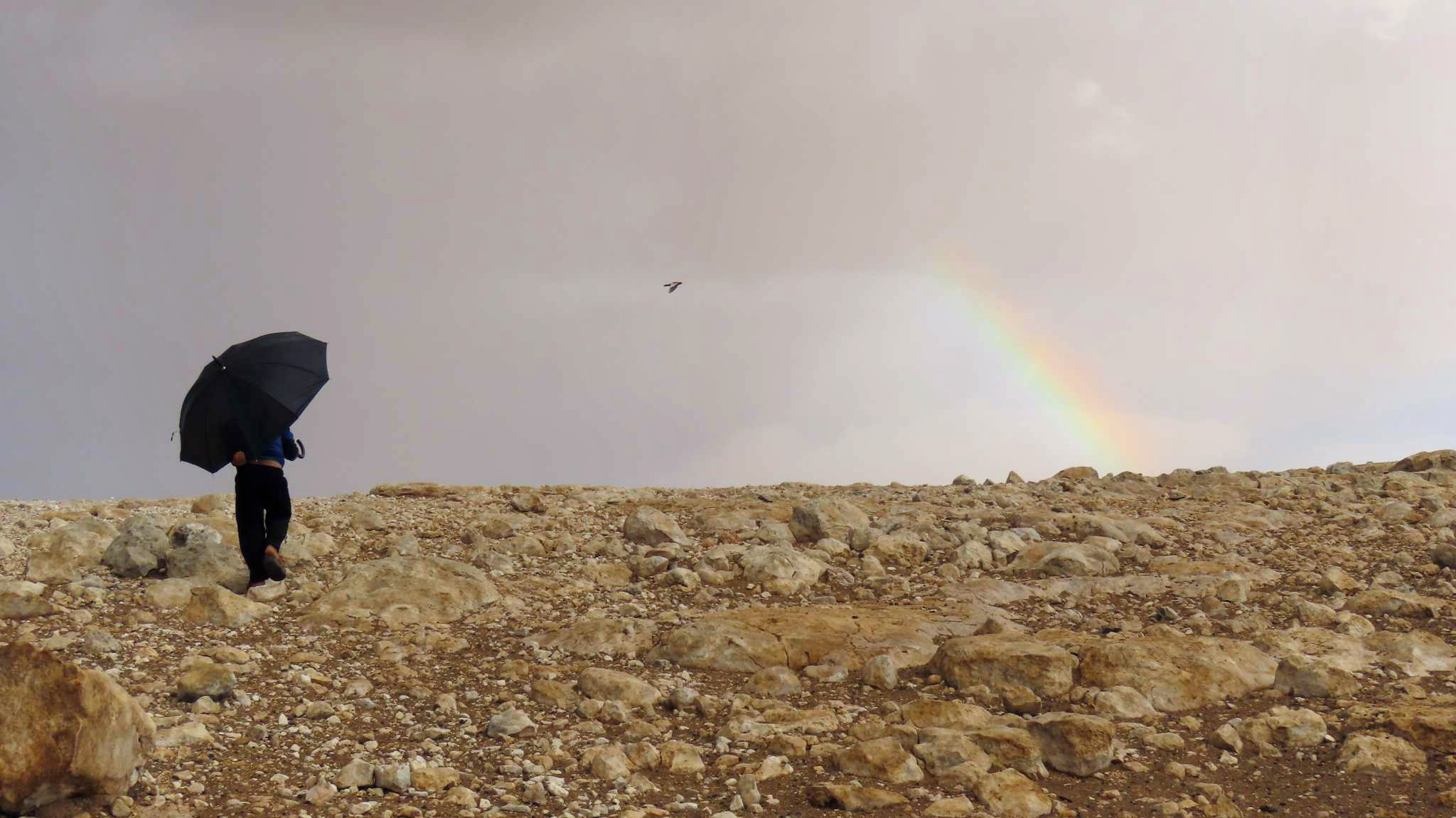
When it rains even the occupation stops and life breathes.
With the fresh and living rain, perhaps a little peace arrives too.
Two children play ball in the middle of the road, soaking wet, laughing.
That is hope.
With the rain, fresh and living, perhaps even the occupation slows.
I cannot let the occupation win, I cannot afford to stop hoping.
As long as Palestinians remain and resist, I want to choose to be there by their side.
A struggle that is not mine, but one I can choose to listen to, stand alongside, support.
If light, beauty and hope die, the occupation has won.
I do not want to die a little every day, fighting until death.
I want to fight until life.
Sumud is staying, it is not yielding to the occupation.
Sumud is being present, it is the bond with the only land you have, your land.
Sumud is resistance, it is living one's own daily life.
It is a capillary resistance, where every village, road and home matters.
Every family, every olive tree.
To resist is to build, to rebuild.
Homes and relationships.
Sumud is a forest that, despite having its trees continually cut down, burned and uprooted, inexorably never ceases to exist, to root downward, and to grow upward.
- It happens, not infrequently, that I find myself thanking Palestine.
The occupation weighing on Palestinians, the total impunity granted to settlers.
I suffer because it is awfully unjust, and I feel rage and I feel pain.
But I learn from Palestinians what it means to resist, to love, to be free.
No, you will not have my rage.
Thank you, Palestine, for teaching me to remain human.
Thank you, Palestine, for teaching me to give value. To homes, roads, trees, times and people.
Thank you, Palestine, for teaching me to simply be. To be present in the unresolved, in the night watch, in the silences, in doing nothing. In human relationships, in sharing.
Thank you, Palestine, for teaching me the meaning of staying, of resisting, of inhabiting.
Thank you, Palestine, for teaching me to lose, to carry nothing, to be irrelevant, to deconstruct myself.
Thank you, Palestine, for teaching me that one can always choose.
The occupation sets the rules, marks the time and decides the spaces, but Palestinians show me what it means to choose not to play by its rules, to choose not to surrender to one's own rage.
Thank you, Palestine, for teaching me that I must listen to my rage and my pain, but I can choose what to do with them.
A rage that sustains resistance, a pain that teaches love.
Thank you, Palestine, for teaching me that I can choose how to respond to violence.
The control of my own reaction, that I will always be able to hold in my hands.
Thank you, Palestine.
 OPERAZIONE COLOMBA


