
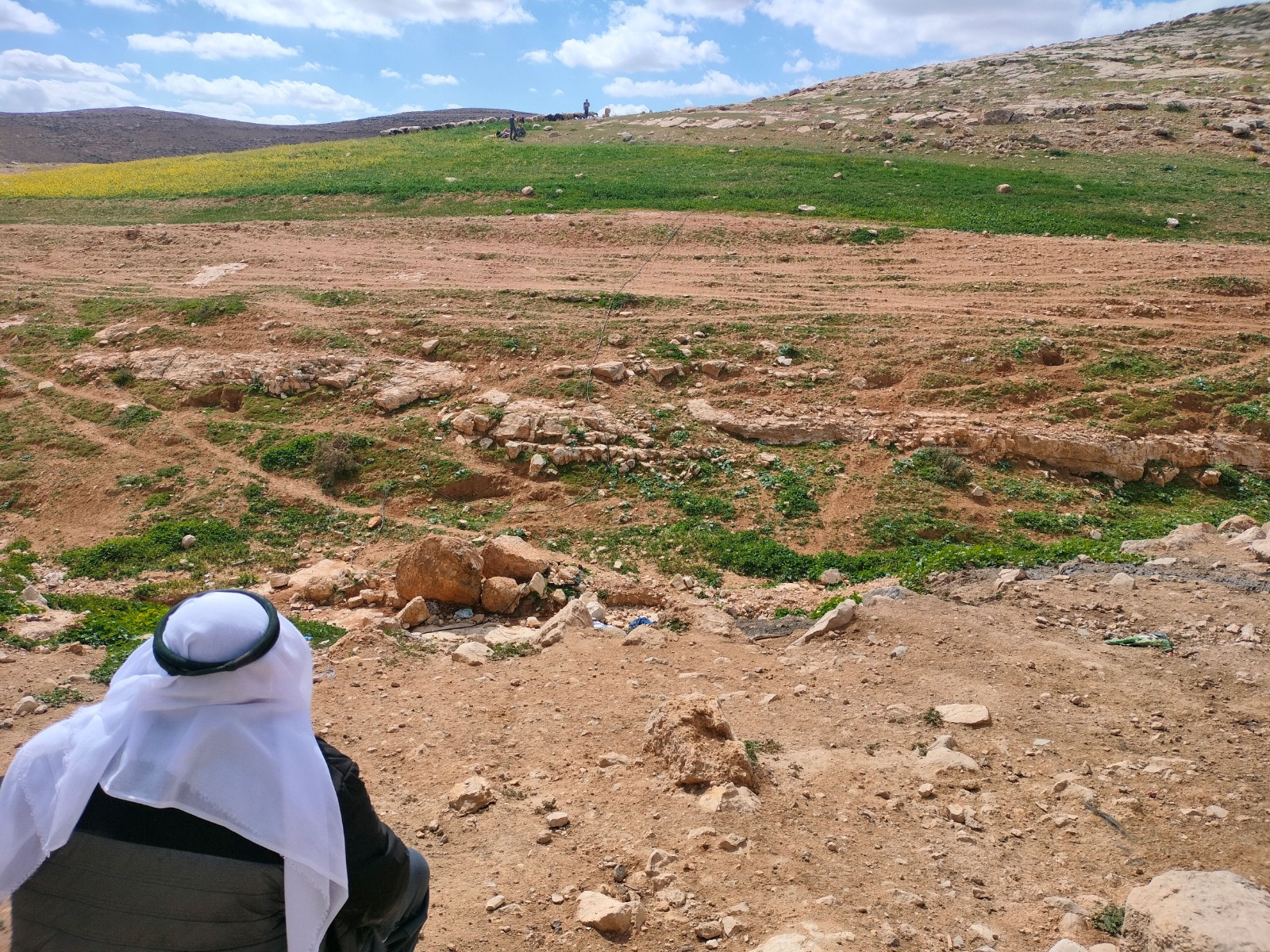
I’m sitting on a rock at the edge of the village, in the middle of nowhere.
It’s less of a village and more like a few houses and a few sheep pens. The “houses” are really just concrete walls topped with sheet metal; the “pens” are stone enclosures covered with tarps.
I’m sitting on a rock at the far end of Tahla, in the south Hebron hills.
I’m looking straight ahead. To my left are Abu Jamal and two or three other men from the village. There are also two women. They’re looking ahead. To my left are two volunteers. They look, through the camera lens, straight ahead. Behind them, to the side, heads peeking out from the corner of the “house,” five or six children. The oldest is about 4 years old. Worried faces staring at the hill in front of them.
I am sitting on a rock at the edge of the village of Tahla, in the south Hebron hills, Palestine, Area C, territory under Israeli occupation. Military and civilian occupation. Below me is a wadi, a small valley. Perhaps, after a heavy rain, a trickle of water flows through it. On the other side of the valley is a green hill dotted with bright yellow flowers.
The perfect place to graze the sheep today.
But today, like yesterday, Abu Jamal and the others cannot go there. There are other shepherds on those hills. They are Israeli settlers. The Palestinians are afraid. Settler violence has escalated in recent days, and on multiple occasions they have damaged property and assaulted people, going so far as to not only injure but also kill.
We’re on one side. The wadi. And the settlers on the other.
I’m no longer sitting on a rock at the edge of the village. A few seconds ago, I stood up and turned on my camera. Two settlers are coming toward us. A quick nod to my fellow activists. They’re here. We’re here. One is a teenager and the other a guy in his twenties, wearing John Lennon-style sunglasses. They’re getting closer and closer, provoking us, taunting us… they look cocky, acting like bullies. The Palestinian men also stand up and face off with the settlers. Not exactly face to face.
I’m standing in the middle.
The teenager mocks the people present. I look him in the eyes. I’m prepared for these moments; I know it and I feel it. He can’t hold my gaze, looks away, and carries on.
The Palestinians don’t give in to the provocation. Meanwhile, a shepherd calls out to the Israeli police, “Did they beat you? No? Then what do you want?”
After a while, I don’t know how long, filled with tension, they turn back, cross the wadi, and continue grazing their flock on Palestinian land.
I’m still sitting on a rock at the edge of the village, looking at that yellow and green hill in front of me. There’s no one else on my left. Abu Jamal has moved further up; he’s keeping a close eye on the settlers.
The children are no longer behind me. The volunteers on my right are gone too. After sitting down with the women and children, they’re now playing with them. They’re playing musical chairs. The children are laughing! You can tell they’re having fun and are happy!
Abu Jamal looks over at them and smiles… he can’t resist taking a photo with his phone. He motions to his wife, who has just stepped out of the house; she looks at the little group with the ajaneb (foreigners) and laughs.
You can see the settlers are watching that circle of laughter and joy, too. I wonder what they’re thinking, I think to myself.
I think they’re caught up in a massive injustice.
I think… why take it out on those people? What have they done wrong?
I think that children, all children, indeed all people, have the right to a full life.
I think that sometimes it takes very little to change the atmosphere of a situation, just a circle dance… just a little humanity.
I think that one thing we can do is simply be with people and share their pain. Or touch together a fleeting moment of serenity… a flash of love!
I’m sitting on a rock at the edge of the village of Tahla, in the south Hebron hills, Palestine.
I’m on the right side!
A.L.
 OPERAZIONE COLOMBA


