
Diary of M.
How does the saying go? If you want to make God laugh, tell her your plans. Or something like that. If that’s true, God—or whoever is in charge—must have been laughing her head off over the past year of my life. Since I don’t believe in God, the only one who (didn’t) laugh was me.
I thought I had to wait for a definitive answer before writing anything, but nearly six months of limbo have passed and that answer is slow in coming. I wanted to wait for the perfect moment to wrap things up, when—so I hoped—my emotions and thoughts about this whole process would also take on a coherent structure. But after six months of waiting, I’m resigning myself to the fact that I don’t know if that moment will ever come the way I had imagined it.
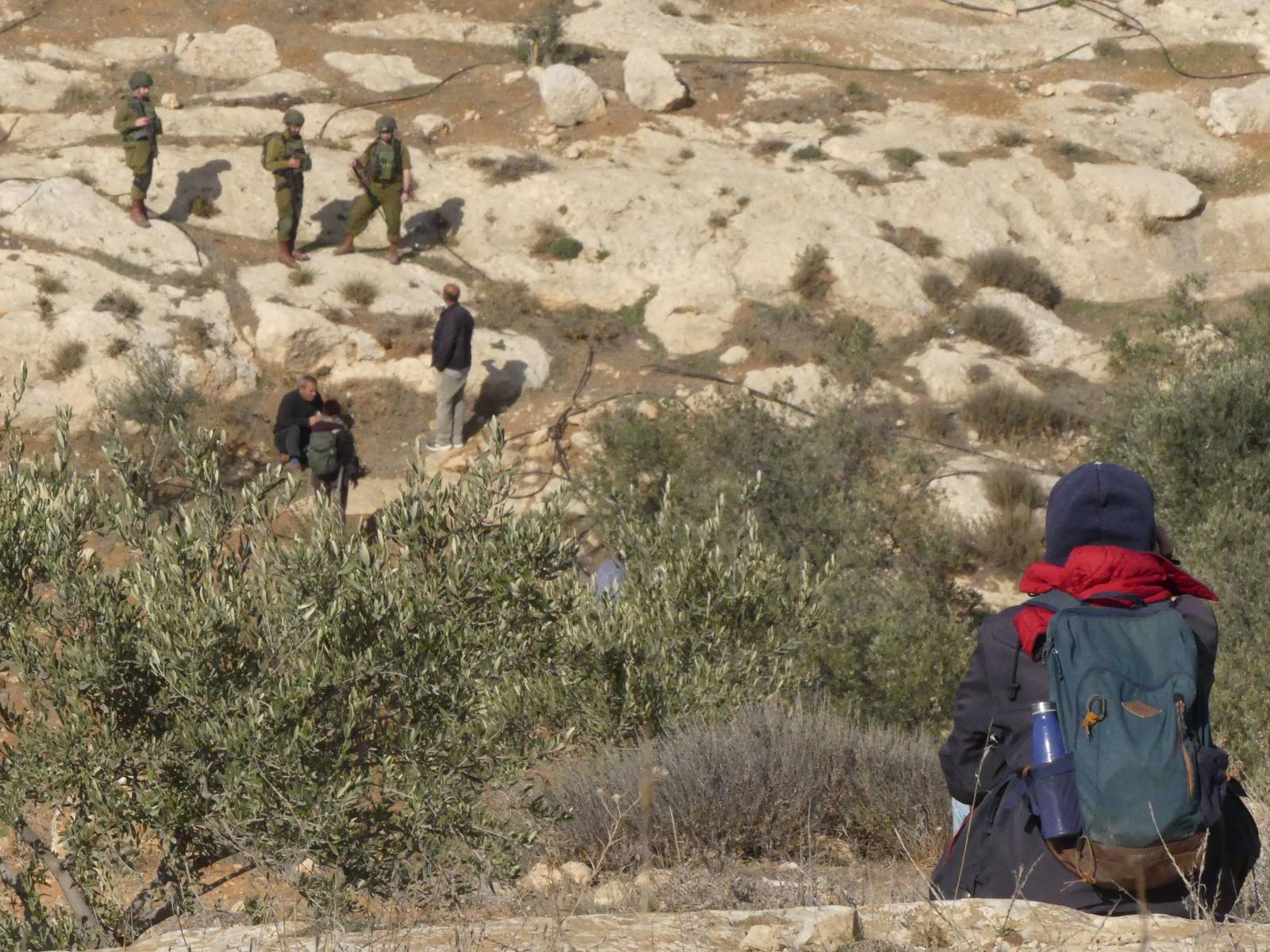
A year ago, I was in Palestine, and after a long process of questioning the parliament of my fears, I had a list of pros and cons in hand regarding my willingness to commit to be a “long-term” volunteer. My fears ranged from “not being able to read anymore”—who has time for that?—to “losing touch with my body”—anyone who’s gone three months on sugar, carbs, and little exercise can understand—to the ripple effect of “financial instability”—“leaving my home in Vienna”—“potentially jeopardizing important relationships.” This list, in various forms, was reviewed by everyone in my life who would be most affected by this choice, and finally, after months of conversations and sleepless nights, I knew I had to put into practice what I had already realized in 2016, my first time on the project. I packed up three years of my life in Vienna, took the boxes to my mother’s house, and began preparing for this new phase. I was afraid I wouldn’t be up to the task; I knew I would face many insecurities, both material and emotional, but I felt ready.
I saw this decision as the culmination of a year and a half of questioning the meaning of living a nuclear life, devoted to a career and personal survival. For the first time, I found myself in the privileged position of being able to take the time needed to do something that would bring me closer to those communal ideals that I believe are the antidote to the crudest form of individualism and, consequently, to a certain kind of moral and political fascism. I was ready to reunite with loved ones and dedicate every part of my life—not just the scraps—to Palestine. The fear of what prolonged exposure to the violence of the occupation might entail was far outweighed by the joy of being able to put my body and mind at the service of something greater than myself and that I feel is profoundly right.
I hadn’t even considered the possibility that I might not be able to leave at all. Like all activists who confront the Israeli occupation system, I had anticipated the possibility of being arrested and banned from entering the country. In hindsight, I realize that this was a purely theoretical exercise; it didn’t account for the possibility that I might not be able to return at least one last time. Israel’s Immigration and Population Office had other plans. In August, I applied for the Electronic Travel Authorization (ETA), which has been mandatory since January 2025 to reach Israel’s borders. “Denied” was the word that, after a few seconds, stared back at me from the other side of the screen.
What followed this first email is a very personal story, but one now familiar to the world of Palestinian solidarity—and beyond. These past months have been a battle against windmills, a futile dialogue with the disarming violence that is bureaucracy. In a system designed from the ground up to give you no definite answers, to bounce you from office to office, yet effective in its one true intent: to silently and wholesale prevent the presence of international solidarity in Palestine.
An arrest can cause a stir; after all, even the European governments most aligned with Israel have to pretend to care about the rights of their citizens who end up in the custody of the world’s most “moral” police force. Besides, an arrest requires multiple people to be involved, a certain degree of creativity and legal interpretation, the cost of detention, and the possible deportation of the activist. It’s inefficient. It’s much better to leave the job to a centralized system that, following unknown criteria, notifies the person that they will no longer be allowed to enter that country. For how long? There’s no way to know. But don’t worry: “Should you wish to review this notification, you are required to attend the nearest Israeli consulate to your place of residence and apply your request there.” Which is bureaucratic jargon for “we’ll wear you down until you no longer feel like playing catch with a rubber wall and you’ll resign yourself to the fact that you won’t see those hills again, you won’t eat Aisha’s Maqlube, and your life plans are on hold until further notice.” Clean, efficient. It requires only the methodical collection of data on as many people as possible who are in a place where, according to Israel, they shouldn’t be. No drama, no Facebook posts from the Minister of National Security: just good, old systematized bureaucracy.
Here, for me, begins a story that is harder to tell. It is a story that, to be honest, must start with how I had imagined I would react to that fateful moment of closure. It is the reaction I had been rehearsing ever since that email arrived, on an ordinary August afternoon. Dressed in mourning like a Sicilian widow, not a single tear on my face, in a resigned yet defiant tone, I would have declared: “This story is bigger than me; the struggle continues. I knew this could be a risk I was taking, and as long as these are the risks, they are nothing compared to the life of a Palestinian.” Curtain, applause, admiration. Stripping away the layers of melodrama, this is the most rational response that the part of me aspiring to a paradigm far removed from the limelight of the struggle would always like to embody.
It’s true: what I’m being asked to “sacrifice” is very little compared to what a Palestinian goes through. But in my haste to put into practice a response that I believe is right in principle, I silenced all the other parts of myself—far less honorable—that, at that moment and in the months that followed, struggled to accept that my plan, so well-structured, had not come to fruition. One of the thoughts I’m most ashamed of—and which strays far from that ideal of selflessness mentioned above—was that it wasn’t fair for me to get kicked out without any honor. Where honor would have meant at least an arrest. If not an arrest, at least the chance to prove my worth on the field. I didn’t feel up to the task: not only compared to the Palestinians, but also to other comrades with a history of activism far more admirable than my own. This would have been my moment to put myself to the test and prove to myself that I was up to the task. Of what? It’s a legitimate question that would require many more pages of explanation.
The other thought I’m ashamed of—perhaps even harder to admit—was the sense of relief I felt. Relief because I wouldn’t have had to go on the field right away—at the time, I still thought a solution would be found within a few weeks—and so I would have had a little more time before facing the confirmation of my inadequacy, which would have revealed that, in reality, I’m not as brave as I thought and therefore not suited to being there.
I have rational arguments for all these thoughts, and I’m not sharing them to seek reassurance. The reason I’ve chosen to share them is that, by digging beyond that first layer of insecurity, more existential reflections have opened up for me.
Questions like: If I can’t do the kind of activism I set out to do, who am I? If I’m really as determined as I claim to be, what should I do if the plan doesn’t work out? Staying in Palestine as a long-term volunteer was my momentary answer to a world that would have us focused on survival, frightened of the other, and therefore determined to do whatever it takes to keep what scares us at bay or suppress it. In the crumbling of my plan, the question remains: in what other way can I live out those ideals? The fragility—and at the same time the arrogance—of having a plan in the face not only of life’s uncertainty but also of the violence of a far more methodical plan, represented by the Israeli occupation and, more generally, by the entire system of power we face today, has led me, once again, to question the meaning of resilience. During this time, I’ve spoken with many people in my life who haven’t made the same choices as I have, but who nonetheless find themselves amid the rubble of projects shattered by the insecurity of our times: jobs that vanish, the struggle to keep close-knit communities alive, urgent questions about how to avoid a new world war, preserve a moral compass, and, quite simply, survive. I inevitably returned to those hills and to Basil’s words: “You have to get used to being a loser.”
I am surrounded by losers, and I feel like a loser myself in this twisted game we’ve been forced to play. But in those moments when I manage to set aside my own precious plan and look at the ways in which the world’s losers keep on building, I see that there is a beautiful kind of defiance in resisting despite everything. And I have also seen that resistance in the refusal to be crushed by a failed plan and in the creativity that springs up from the cracks of what didn’t work. In this, the Palestinians are, despite themselves, masters. Without idealizing either the Palestinians or the loss, I try, from afar, to cling to those hills and to what they continue to teach me: that resistance is a daily practice; that we cannot practice it only when it is comfortable or convenient for us; that we will continue to grapple with our ego and our privilege, but that, even in this, we are never alone.
 OPERAZIONE COLOMBA


