
Palestine gave me a new name, one that no one had ever pronounced before.
Palestine welcomed me like no one ever had before.
It welcomed me with sweet tea, in front of a fan or around a stove.
It welcomed me with the acrid smell of taboon and its strange tobacco, with dust always on my shoes and flakes of sheep's wool carried by the wind.
Palestine welcomed me at night on mattresses on the floor with heavy blankets, welcomed me with breakfasts of warm bread, oil, and bandura or with endless trays of rice.
Palestine welcomed me with hands kneading dough at dawn, hands working the fields, hands picking olives.
Dusty hands, calloused hands, tired hands, hands marked by handcuffs, but still capable of warmly greeting a stranger and preparing a bed for them for the night.
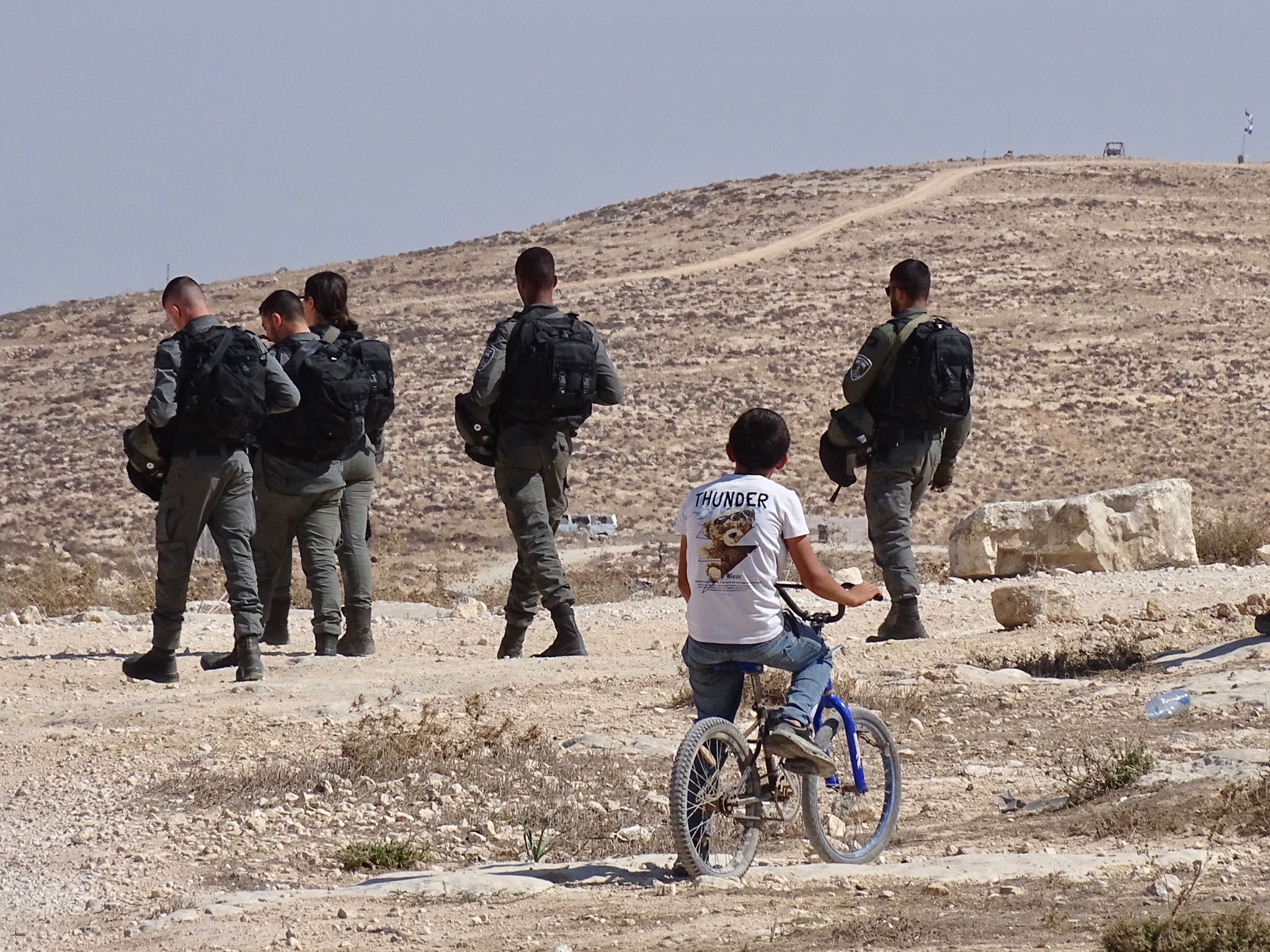
Palestine has embraced me on its hills, in its fields, and under the shade of its trees. As I traversed it, Palestine revealed its land marked by paths interrupted by settlers' roads, a land scattered with watchtowers that monitor every step as if walking were a suspicious act, a land marked by yellow gates controlling entry to villages, and a land littered with large concrete blocks establishing arbitrary checkpoints along the roads. Palestine showed me a landscape crossed by bulldozers ready to demolish houses and by military jeeps poised to storm a village.
Thus, even with something as simple as a walk or a drive, Palestine illustrated how occupation permeates daily life: fragmenting geography and forcing people to painstakingly piece it back together each day, even just to return home.
I came to understand that occupation is not only felt when a soldier stops you; it is felt when you can no longer walk freely, when you must learn to think in alternative trajectories.
Occupation is felt when the day is measured by what cannot be done: not working the fields visible from the settlers' enclaves; not using the tractor for fear of being noticed, but plowing with a single donkey; not using the well beneath the new outpost; not taking that road.
Occupation resides in the unannounced prohibitions, yet known by all. It exists in the narrowing space around bodies, in the grip of the infinite addition of settler homes starting from the crest of the hills, tightening evermore around each village. Palestine has shown me the dead it has lost to the occupation, the wounded, the abducted, the imprisoned and tortured, the assaulted, the widows, the orphans, the villages razed to the ground; but if someone were to ask me what occupation truly means in Palestine, I would probably respond with much more mundane events.
It’s having a barbecue and, amidst jokes and laughter, seeing the young men jump up to check on the sound of an engine that isn’t immediately recognized; it’s playing tarnib around a table and suddenly having to turn off all the lights to avoid attracting the attention of the army stationed in the village; it’s boiling water for tea without knowing if there will be time to drink it; it’s a boy in Shabel Boutum sleeping outside his front door, clutching a club for fear of settlers arriving at night; it’s a house completely stripped bare but equipped with security cameras and lights that are always on; it’s Abu Ayoub sleeping in the sheepfold to tend to his sheep; it’s the constant dance of lights from giant flashlights checking for any noise in the dark.
Occupation is the uncertainty and fear in one’s bones, the sleepless nights, the inability to go grazing, the inability to work one’s lands, the compulsion to stay in one’s own home even knowing that, for Palestinians, there is no longer anything that is truly theirs.
Thus, I discovered that occupation is the waiting for violence to become flesh; I learned that the most violent siege is the non-place: neither the war as one might imagine it, nor peace, just a waiting for the tightening grip of the surrounding world.
Yet, in this confined space surrounded by settlements and violence, I saw the vastness of human dignity.
The stubbornness of life.
The kindness that arises despite fear.
A tenderness that no siege has been able to scratch.
A continuity that defies interruption.
A daily gesture that becomes resistance.
Tea stubbornly boils at the Benets' house, Hafez plants fruit trees in front of the guest house with a demolition order, the shebab meet at our house to smoke hookah and play guitar, in Mufaqarah they build low walls and benches around the stove to keep watch, on the day of the occupation of Sarura small olive trees are planted on the hill opposite, the Shawawin go grazing up to the Israeli flags planted on the surrounding land, on Friday afternoons they play soccer, Aisha continues to hang her laundry a few meters below the soldiers in Khelly, Sheik Said, whose leg was not “stolen” by the settlers, returns to his fields every day.
Amidst all this resilient everyday life, I saw humanity become greater than pain.
The steadfastness that is not proclaimed, the dignity that does not retreat, the life that persists, even in the face of those who would like to erase it.
I understood the political act of planting a seed on land that is being torn away.
I understood that the simple act of praying, bowing down on one's own land, has a profound meaning when the land of your people is being taken away from you through violence and abuse.
In this landscape so full of humanity, I felt myself change, because the beauty of this resistance creeps inside you, stronger than any words (even badly translated ones).
A beauty not meant to console, but to remind us of what human beings are capable of, even when everything pushes them towards the opposite.
So now that the time to leave has come, perhaps it is not the distance that weighs on me, but rather the mixture of horror and wonder at what I have seen.
And so I leave with a complex, bittersweet feeling: the melancholy of leaving, the gratitude of having been able to see the purest humanity where it might not have existed at all, and the awareness that some lands and some people bring you back to life even as their world is limited.
And now, even though I will return to my usual old name as it has always been pronounced, I know a little better what it means to be human.
———————
Palestine and its people have shown me that to resist is to exist, to exist in the most human way possible.
 OPERAZIONE COLOMBA


