
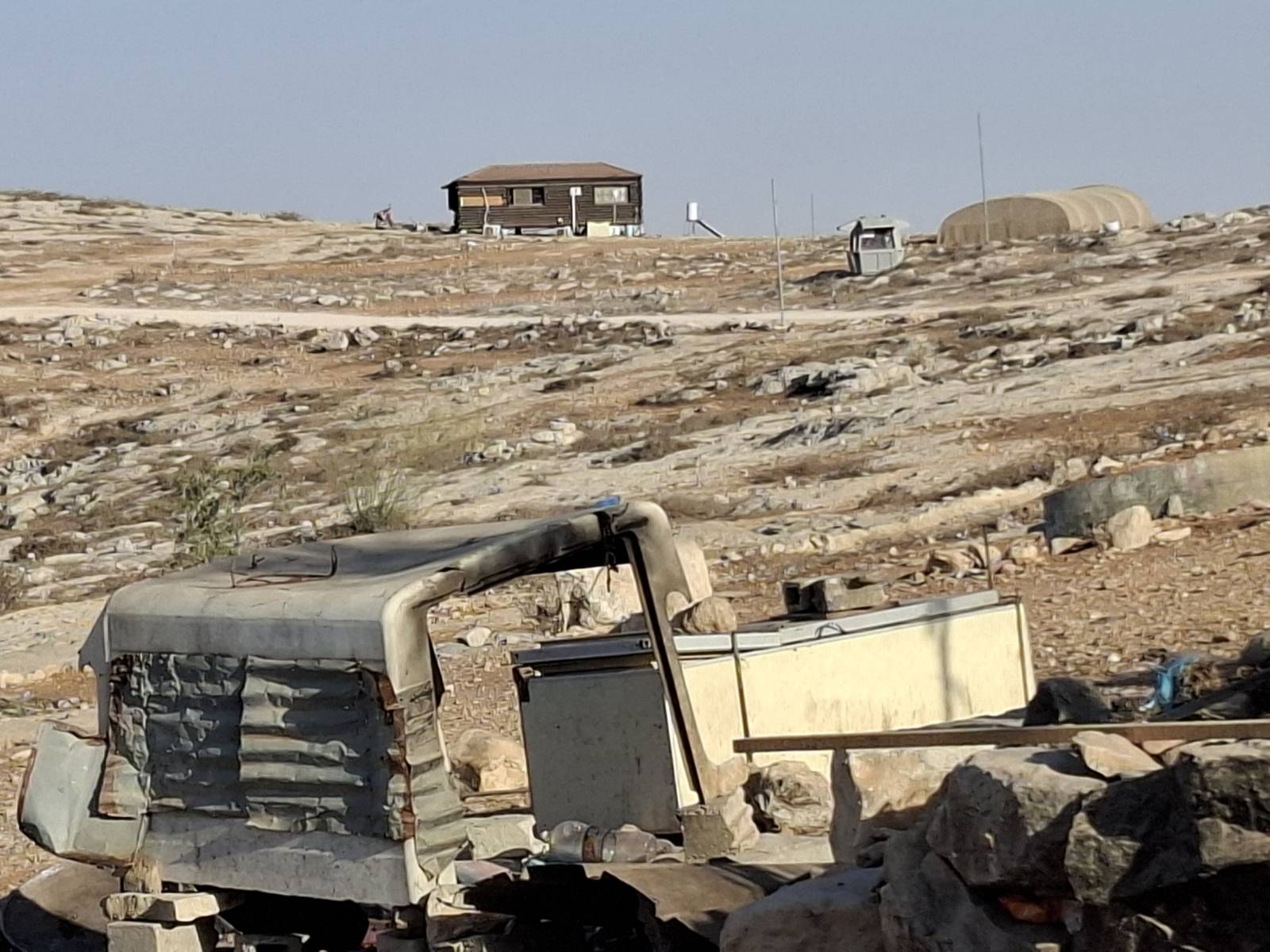
Autumn nights are very long in Masafer Yatta: dogs bark all night long and every noise becomes frightening when you have to keep watch to make sure that settlers don't leave the outposts. On Saturday evenings, they often celebrate Shabbat in this way, armed and hooded, hunting Palestinians, ready to destroy houses, wreak havoc in fields, slaughter sheep, and sometimes even beat entire families with sticks.
Camera footage of Palestinian homes shows scenes straight out of a horror movie: masked settlers throw terrified white goats to the ground and beat them with sticks, with blind fury and unheard-of cruelty.
In November, when the rocky hills are shrouded in silence and the hours pass slowly, everything is quiet at nine o'clock in the evening. The Palestinians here eat early, follow the rhythms of nature, and then go to rest, but always with one eye open to make sure nothing happens. There are now some villages in the area where a 24/7 presence is necessary, attacks are frequent, and outposts are constantly expanding; caravan after caravan, the hilltops are now almost all occupied, and the space between the end of the Palestinian village and the beginning of the illegal Israeli outpost is reduced to a few meters. In Um Durit, for example, the Palestinian village now increasingly resembles a drowning island, surrounded by a fence that is inexorably closing in on its living space. Only one family lives there, with a few olive trees, a vegetable garden, chickens, rabbits, pigeons, and a cow. The sheep have all been stolen by the settlers, who even allow their flocks to roam on Palestinian land, feeding them with the few plants belonging to the same family from whom they stole the animals. They are aggressive settlers, armed with automatic rifles, and their teenage children have the mocking smile of impunity plastered on their faces. But at the same time, they teach the youngest child to ride a bike and unload groceries from the trunk of the car—repeating the same gestures I make every week. They live in the infamous ‘gray zone’, which hides brutality behind the facade of an ordinary family.
The nights are also very short in Masafer Yatta, they pass in an instant, amid the lights of the settlers' torches and the flashing lights of the army and police, hunting for Palestinians to arrest or internationals to expel. Sometimes we have to move quickly on the steep slopes of these hills, running in leaps over the stones to avoid being seen by the uniformed occupation forces, who provide a security shield for the expansion of the settlers. Identification can mean immediate arrest and expulsion for us, thus extinguishing another spotlight on human rights violations against Palestinians. Fortunately, there are nights when we manage to regain control of our time, dictating the rules of its passing, deceiving the occupation. These are the best nights, flowing peacefully, amid the winks and laughter of a game of briscola with the Palestinian boys. My team lost this hand of cards, but for a few hours we all won together.
 OPERAZIONE COLOMBA


