
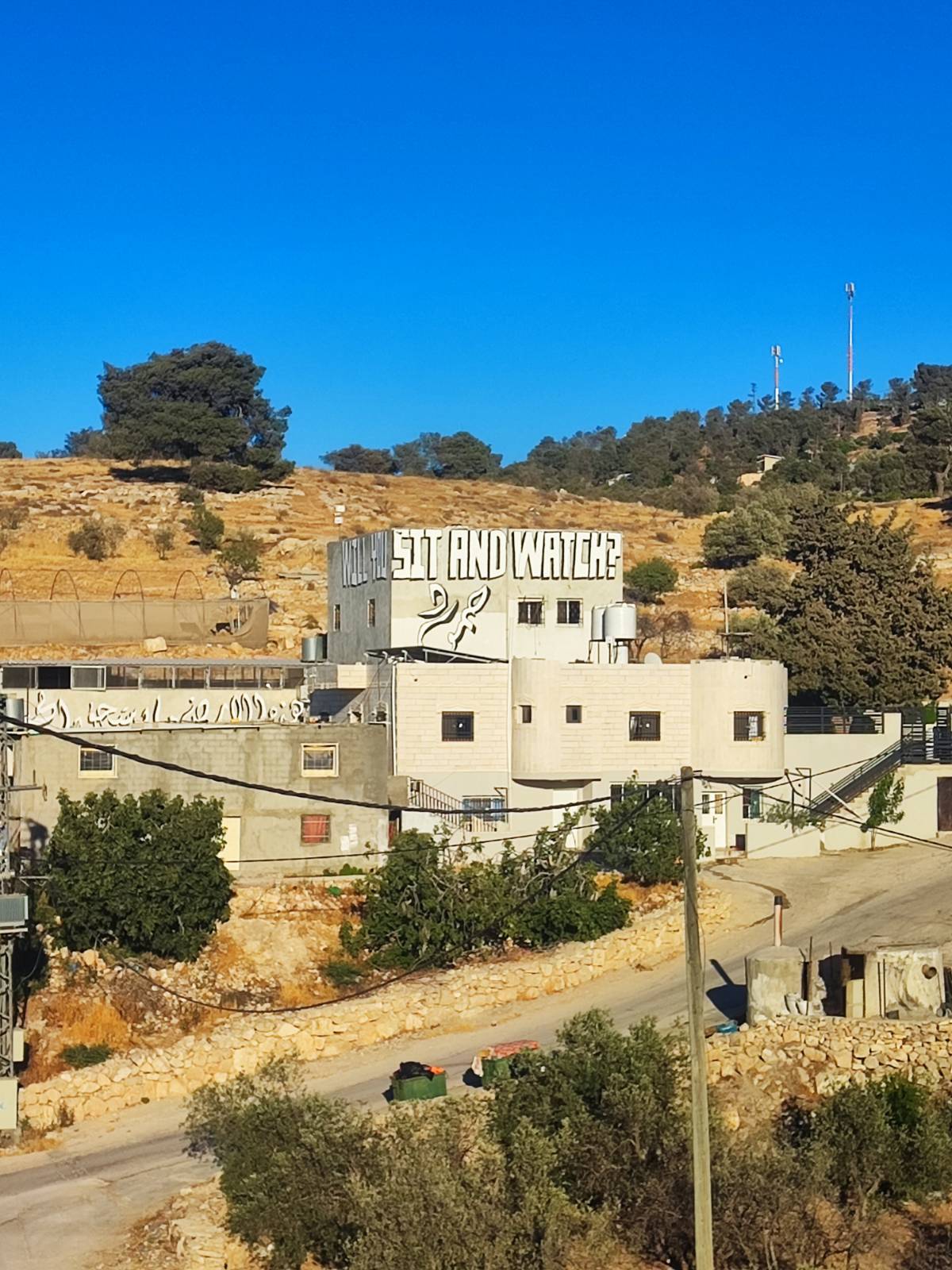
A difficult month to recount in person, even more so to report in a few lines, but I will try. Never would I have thought to be saying things like “it’s a situation where you just had to be there”, but now I know that it’s true; you need to live through the occupation to understand it.
On my first day keeping watch, for example, I already understood how the distance between a Palestinian village and the ever more numerous colonies had been reduced, and how much closer the previously noted outposts had gotten (the ones that are theoretically illegal, even for Israel).
It is from there that the settlers’ daily attacks are launched, with the tacit blessing of the police and military, who, when they do show up, simply suggest that the settler “move a bit over there”, without any repercussions.
The settlers, to be clear, are mostly armed kids, dressed up as farmers, who invade Palestinian land with their sheep and damage their fields with the sole intent of provoking a reaction- one that would be immediately punished - and of driving the Palestinians to exasperation, until their eventual withdrawal from their lands.
But this is exactly the point: the key to their nonviolent resistance lies in their persistence.
And the volunteers simply adapt to this, reporting all they can.
While I capture the umpteenth attack, the people of the village are beside me, with plates full of fruit and eyes full of gratitude, just for taking a couple of photos.
After a month, there are still too many images in my mind, images that I try to give some kind of order to, or rather some kind of sense.
I think of the nights spent guarding the distant villages in the middle of the Firing Zone, looking up at the sky, the Iranian missiles like falling stars, with a bright-eyed child who never stops smiling and tells me that “she is not afraid of anything, only of Allah”, I think of the hours spent under the sun accompanying the farmers out to the pastures, the endless minutes watching one of them be blindfolded, handcuffed, dragged into a vehicle, beaten and left in the middle of nowhere, all just for having dared to graze on his own land, for having dared to exist.
I think of all the times when any kind of intervention is in vain, like during a demolition, when one can only helplessly witness the destruction of homes, cisterns, grottos, and hopes.
I think of my conviction that the resistance of tomorrow will be carried out by the young people of today, embodied in the indelible image of a child who, in the middle of a village raid, calmly rides his bike between a platoon of soldiers, unfazed by the danger.
I think of those who have always stood by me, even from afar; I think of Operation Dove, whom I can never thank enough for giving me this opportunity.
I think of the words of a Palestinian, who tried to reassure two activists facing the risk of deportation, saying that this was just one of the thousands of effects of the occupation, which tries in every way to discourage our hearts and destroy our dreams of peace, but “the will, that they will never kill”. These words, spoken by someone who has felt the resistance in his own flesh and skin since the moment he was born, seep into your veins. Even if this is not your battle, you understand that this life lesson will always burn in your chest.
I think of the constant state of alert, of the anxiety of being woken up for an emergency or stopped for a check, but also of the constant awareness that the stress we internationals feel is not even remotely comparable to the everyday, years-long suffering of those who have never had our privileges or our rights.
And it is from this that my plea is born: for all of you to take action, to challenge the complicity of the West, to tear down the wall of indifference in the international media, to prove that we are on the right side of history, and that even with the smallest act, history can be changed. We will meet again, inshallah.
Boris
 OPERAZIONE COLOMBA


