
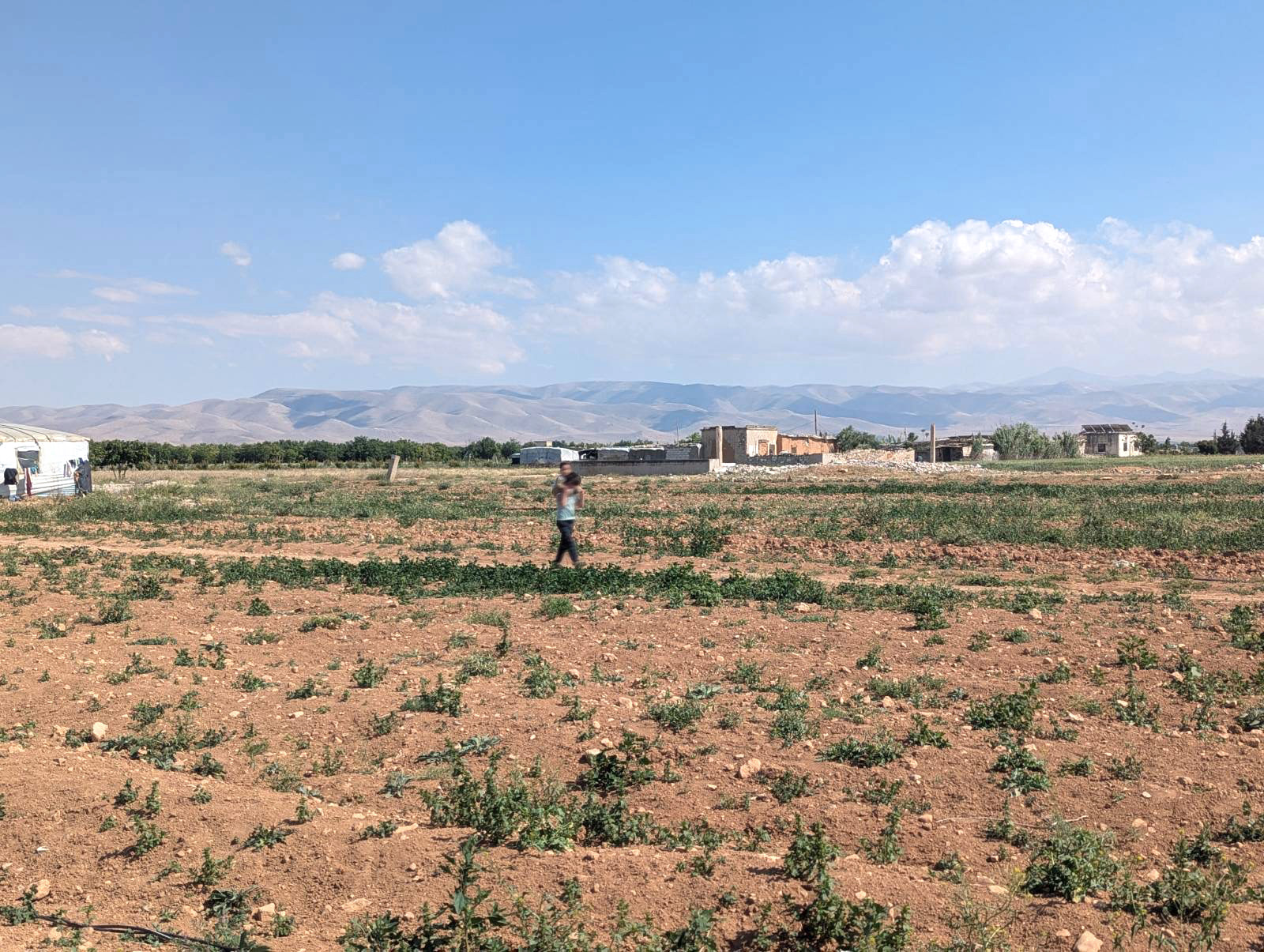
At the end of May it has been 8 months since we moved in Quseyr, eight months since we have a home, eight months since we started comprehending this country, this city, these people. Everyday we go deeper in the rooted culture, in the ideas, experimenting food, listening, having questions. Different places have different stories, people that lived similar lives, but never the same, and are now elaborating their pasts, each their own way. In the last period we focused our attention on the riff (countryside), starting a project a project of social-emotional sensibilization with the youths — that is not the topic of this article. It is a reason to meet other people, to talk, and create spaces to share. To keep solid the relationships we brought over from Lebanon and to make new ones. It’s all a way to be together, to share some time and space, to establish relationships. To listen, to stop, and let people narrate their stories. The story of Aisha is one that we know very well; she came back to Syria at the beginning of 2026 with her husband and their six children. It is a family that Operation Dove knows from Lebanon and since we live close by we frequently visit them.
What they call “home” are two rooms, ugly and bare, in grey bricks and cement, a handful of kilometers from the Lebanese border. For Eid Al-Fitr, at the end of Ramadan, the youngest daughter had her father buy the traditional moon-shaped fairy lights and lanterns and had them hung on one of the walls. The fasting ended over two months ago, but the lights are still there: “they decorate”, says Aisha, “and bring joy”; and in truth they are actually the only “luxury” of the house. Their family is one of many which, coming back, has not received any kind of help: neither from the State, nor from the UN, nor from any other organization. “In 2012 we escaped in Lebanon and we had nothing; now we’ve come back home and again we have nothing; on the contrary, it’s even worse. In Lebanon there were Associations ready to help Syrian refugees, while here there isn’t any kind of support”. In the countryside only civilians rebuild, at their own expanse and without any economic incentive. In Aisha’s village, even the money to fix the Mosque came from the residents, not from Qatar or from Saudi Arabia, as happens instead in the cities, in Quseyr or Homs. Her husband told us they had to go into debt to buy solar panels, since in the village state-owned electricity does not arrive; the streetlights were damaged during the war, and no one has yet cared to fix them. Maybe it’s pointless to underline this, but being left without power impedes any kind of social and/or work activity in the evenings, especially in the winter, when the sun goes down early: doing homework, heating up water to wash the dishes from dinner, chatting while drinking a cup of tea. And obviously, it also implies a lack of public illumination, with severe repercussions on safety during travel.The same goes for the water: the water supply is now non-existent, and people must rely on the presence of private wells. Before the war every family had one, but nearly all of them have been rendered unusable during the conflict, when the regime and the Party of God destroyed them with rocks or by pouring cement. Only those who could afford the expanse dug new ones. Khaled also lives in a village in the countryside of Quseyr; the one we have with his family is a recent friendship, still fresh, born a couple months ago. He and his wife have five children; they came back from Lebanon four days after the fall of the regime in 2024. “When the liberation took place, it was incredible, I could not believe it! One evening, from the excitement, I came into our tent, cutting the plastic wall with a knife and told my wife that the next day we would go back to Syria; we spent the night gathering our things”. They are one of those families who, coming back, brought with them the tent that for twelve years had been their house, and put it back up next to the ruins of what used to be their home, continuing to live in there. At present, they don’t have the availability to start rebuilding. This year Khaled, who has a degree in Arab Language and Literature, has found a job as professor in his local school. In his village there are five schools, between middle and elementary, but only one is structurally safe. This is the reason why one turn of lessons per day is not enough for all the kids, so there are two: one in the morning and one in the afternoon. Since the funds assigned by the State for education are not enough, Khaled’s salary is paid by an association, but even then, not all teachers are paid. Some dedicate their time and knowledge as volunteers in these schools, which often have neither doors nor windows, nor heating in the winter. Schools where you have to be careful where you step, due to the rubble on the floor, that comes back even if you remove it; schools where there are no textbooks, or where four kids sit at each desk since there aren’t enough. Not to talk about the situation with the toilets: oftentimes kids have to go back home, if during the morning they need the restroom, because the ones at school are clogged and no one is there to fix them. The question people ask is why is the list of shortcomings so long in the riff: is it a lack of resources, or actually a class discrimination, a deep rural prejudice enacted by the institutions? These are areas where the main source of income comes from working the land; maybe that’s why the State is taking so long to get here. And the same goes for the local and international Associations, all gathered in Quseyr, if not even in the city of Homs. There is a lack of interest in these areas where, to give another example, even healthcare has some serious gaps: the sewage system does not work, it takes an hour by car to reach the closest hospital, half an hour for the closest pharmacy. A few days ago Saleh, another friend from the ri__ff, was showing us pictures of a venomous snake he had found in his house, explaining that if something like that bites you, you need to go to Homs for the antidote – as we said, an hour by car from his place – as there aren’t any nearby. And then there is no oven for the bread, malnutrition in children is high, none of the bridges over the Orontes (destroyed by Israel last year) have been repaired, and there are no jobs (or salaries). All these deprivations, these concrete and material problems, then have a heavy psychological impact on everyone. Does it make sense to talk about “groups at risk” or “vulnerable individuals” in this context? Women, old people, children, men, young people, minorities and majorities, middle-aged women: no one is left out, they are all victims of war – main cause of the unstable reality they find themselves in – and of a debatable handling of the post-conflict. Waking up in the morning and still seeing debris, torn-down buildings, reading news of a war a few kilometers away: everything weighs down on their spirits. To this, then, we add the economic and social problems, gaining severity and nearly completely replacing the joy of liberation that Khaled told us about. The initial enthusiasm of December 8th, 2024, is now disappearing, and the fatigue is increasingly visible, especially in the riff. So many fundamental Rights are missing in this corner of the world: from education to safety, to hygiene, from food to water, to work. The hope is that something might change, even if by now the prolonged pressures of Israel from the south don’t leave much room for it. From our side, we keep on being spectators of the life lived in this corner of the world, asking ourselves how to be a bridge between people, ideas, communities and spaces M.

 OPERAZIONE COLOMBA


